
Photo Project: Week 5
For this week's photo, I figured I'd so something related to "Mashramani," which is a national Guyanese holiday that means "celebration after hard work" in Arawak (native Amerindian language). On the 23rd of February every year since 1970, there'a an annual string of parades, steel-pan competitions, and the like. Many have probably associated Mashramani to the likes of Carnival. However, unlike Carnival in Trinidad and Brazil, Mashramani also symbolizes the day Guyana became a Republic.

 The first festival was held in the bauxite mining town of Linden. Ever since then, the festival is featured on several streets in the capital city, Georgetown. The parade usually highlights steelbands playing calypsonian and other music, while clad revelers dance to the beat of the steel-pans. Like other holidays in Guyana, Mashramani witnesses the coming together of Guyana's six plus ethnicities in costumes that are reflective of its multi-ethnic society.
Since I was couldn't be part of the celebrations this year, I decided to rampage through my knicks and knacks here and there to recreate just how festive and symbolic Mashramani is. When I was putting my set-up together, I realized that I didn't have much to work with. So... as usual, I had to improvise. I cut some post-its to substitute for confetti and used my kitty's feather toy to fill in for costume-like features. I also inserted a basket-woven hair accessory to represent the culture of Amerindians, who remain the primary preservers of the old Guiana. And lastly, I included a reveler's mask...
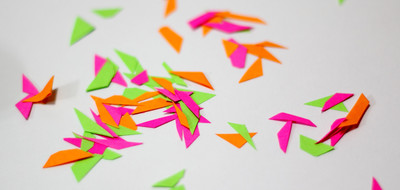 because Mashramani has transformed into a globalized affair with Carnival-like features, rather than the traditional materials used to piece together the floats and costumes.
The items were placed against a white paper background (new addition and trial). After calming my cat down and adjusting the lights, I took about 40 shots from different angles and rearranged the items for variety. Eventually, I decided on this image as my photo for Week 5 of the Photo Project.
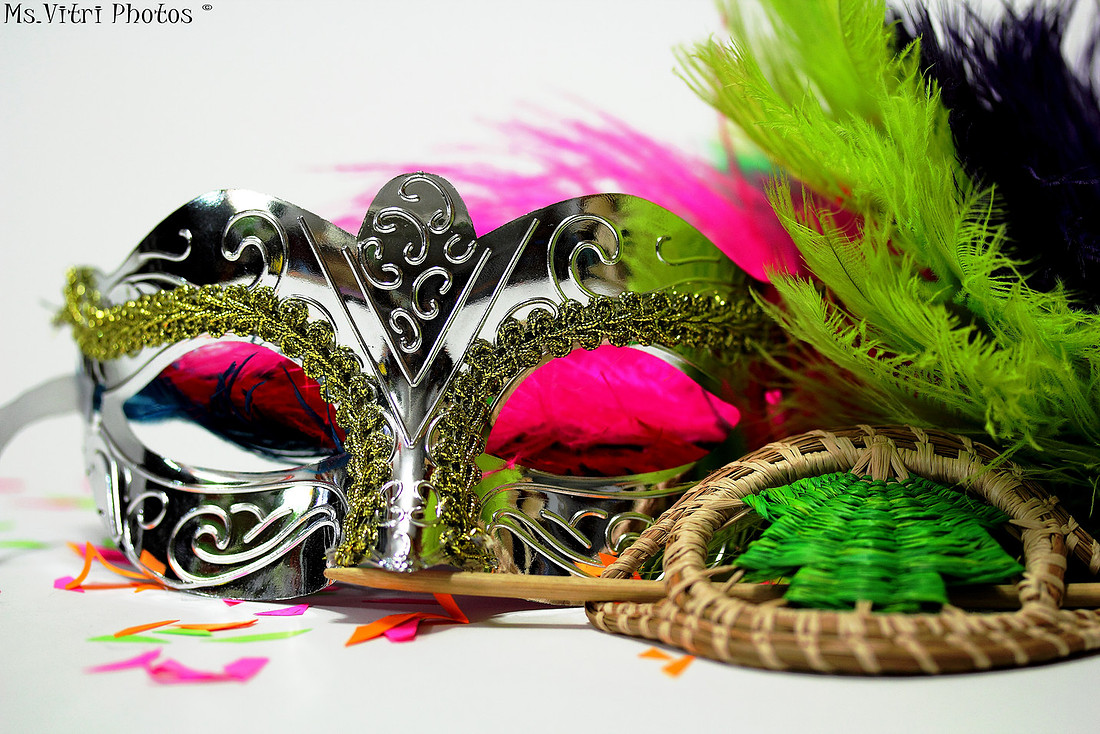
Photo Specs:
For some photos of Mashramani celebrations, see Michael Lam's Collection.
For a reflective piece on the evolution of Mashramani, see Krysta's blog.
