
The Advocate
Just recently, I participated in the 17th Inter-American Human Rights Moot Court Competition. The Moot Court is meant to stimulate the Inter-American Court of Human Rights that tends to proceedings regarding human rights and the like. As the jurisdictional arm of the Inter-American Human Rights System, under the Organization of American States (OAS), the Court seeks to uphold and protect basic human rights in the Americas. Each year, a hypothetical case is drafted to reflect ongoing human rights and international law issues around the world. By stimulating such issues, the competition allows participants the opportunity to represent either the State or the Petitioner. A brief is submitted several weeks before oral arguments for the parties are heard before the Court.
This year, the hypothetical case for the Moot Court involved issues of indigenous rights and the rights of a State to exploit its resources. After signing up for the competition, my co-counsel and I were assigned as the State Representatives for the fictional nation of Atlantis. After discerning the disputes for resolve embedded within the case, weeks of research & brief writing, accompanied by months of preparation, we headed to American University in Washington, DC for oral arguments to be heard by a panel of 5-6 Judges.
Upon arriving at the competition, we discovered that we were one of the only teams who was scheduled to present oral arguments 3 times. Other teams were required to do 2 rounds. After a grueling 1st round, and a much better 2nd & 3rd rounds, my co-counsel and I did not advance to the Semi-Finals, but were more than happy that we finally had the opportunity to rest and just relax as we found ourselves flying out to compete in the Competition 3 days after undergoing two weeks of final exams.
We used the next day to tour a bit of Washington, and paid homage to our case by visiting the Native American Museum of History. On the last day of our stay, we observed the final round of the competition, where the State Representatives from Mexico were declared the winner. Thereafter, we attended the award ceremony and subsequently left for our flight back to the Midwest.
All and all, though it was a hectic and stressful week, it was an amazing experience! Not only were there teams from OAS Member States, but there were also teams from Spain, Belgium, Switzerland and as far as Australia! Some of aforementioned teams were awarded with plaques for Best Memorial & Best Oralist in English. There were also similar awards for Spanish and Portuguese speaking participants. Since the Competition does not yet cater to languages beyond the three mentioned, other foreign language participants registered as English Speaking teams. Of this, Belgium and Romania were given awards for Best Memorial and Best Oralist in English. I was overjoyed at their wins, since they were presented with a double language barrier throughout the competition.
In closing, I would encourage anyone who is interested in human rights, international law and so forth to participate in the Competition. It is held annually at Washington College of Law, the law school for American University in DC. I should note that you do not need to necessarily be a participant representing the State or Petitioner to be a part of the Competition. Instead, you can apply to be a Bailiff (time-keeper), Judge, Interpreter, Coordinator, Observer, etc. If you are interested or know of someone who would be, please take a look at the links below and pass it around!
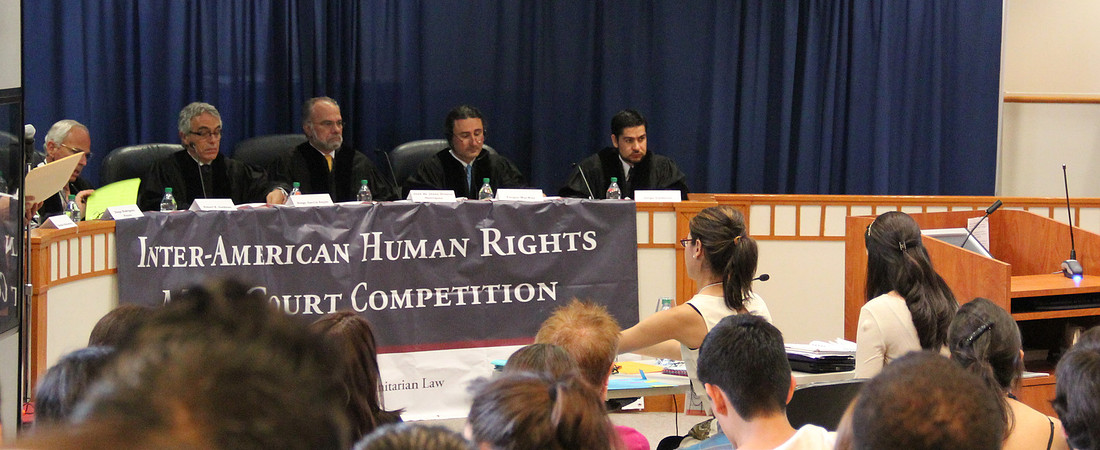

Final contenders before the Court
Other resources:
http://www.facebook.com/IAMOOT
